
MCU-BT Series
Our Products / Emergency Light / MCU-BT
The MCU-BT Series emergency lighting is equipped with a mobile application for both iOS and Android, enabling seamless connectivity between the device and a smartphone via Bluetooth technology. This allows users to monitor the system’s operating status, check battery performance, and configure the automatic system testing, among other functions. Additionally, it features an innovative 3 Steps Charger system (Patent No. 15955),surpassing conventional charging methods to provide complete protection for the battery charging process.The system also includes an Auto Check function that monitors key components of the device, such as the battery, light bulbs, fuses, illumination circuits, and the battery charging system. Any malfunctions are promptly reported to ensure the device is always ready for operation, enhancing reliability during power outages.
Why choose MCU-BT Series emergency lighting from Sunny Emergency Light
The MCU-BT Series emergency lighting is equipped with a mobile application for both iOS and Android, enabling seamless connectivity between the device and a smartphone via Bluetooth technology. This allows users to monitor the system’s operating status, check battery performance, and configure the automatic system testing, among other functions. Additionally, it features an innovative 3 Steps Charger system (Patent No. 15955),surpassing conventional charging methods to provide complete protection for the battery charging process.The system also includes an Auto Check function that monitors key components of the device, such as the battery, light bulbs, fuses, illumination circuits, and the battery charging system. Any malfunctions are promptly reported to ensure the device is always ready for operation, enhancing reliability during power outages.
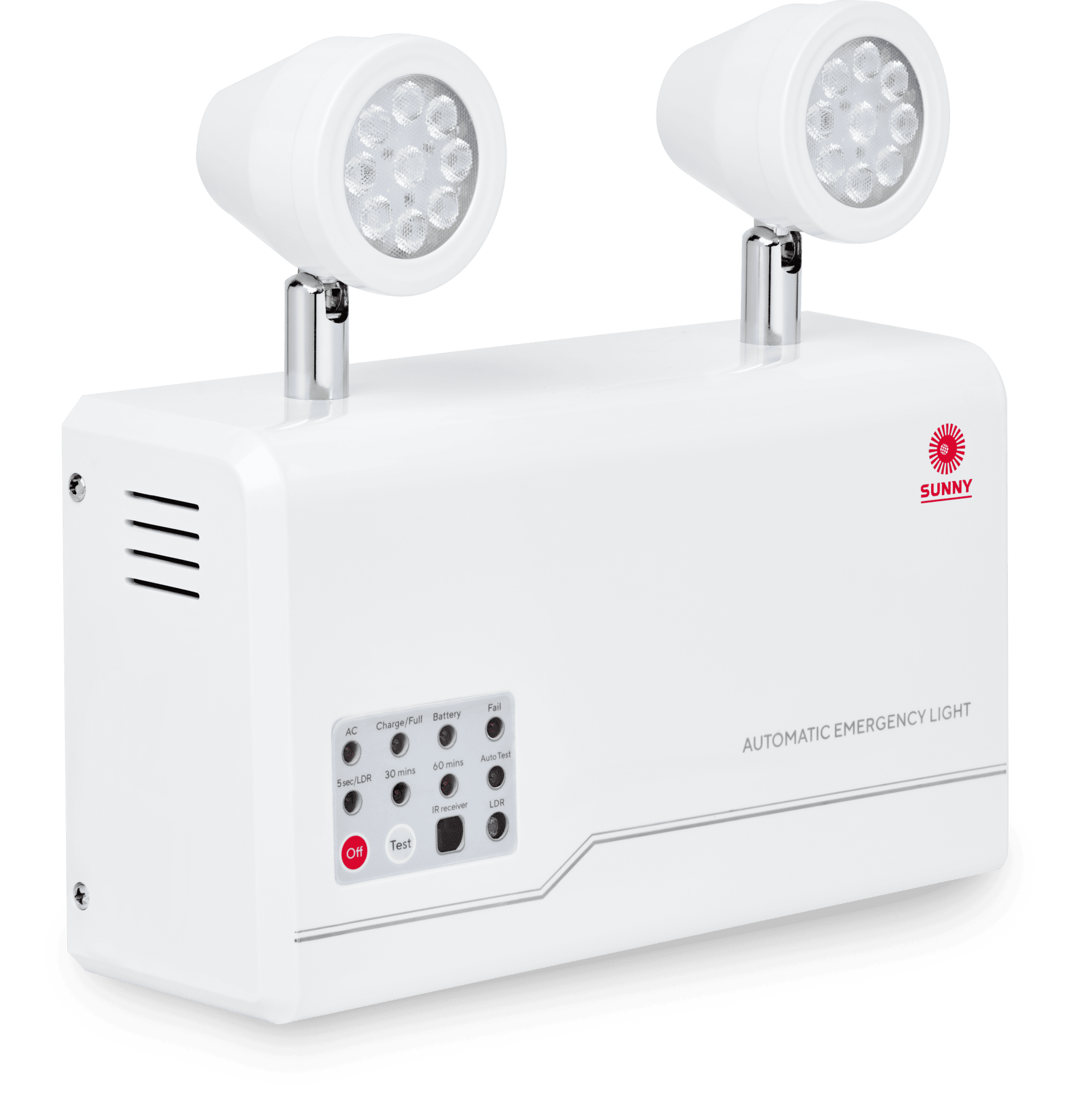
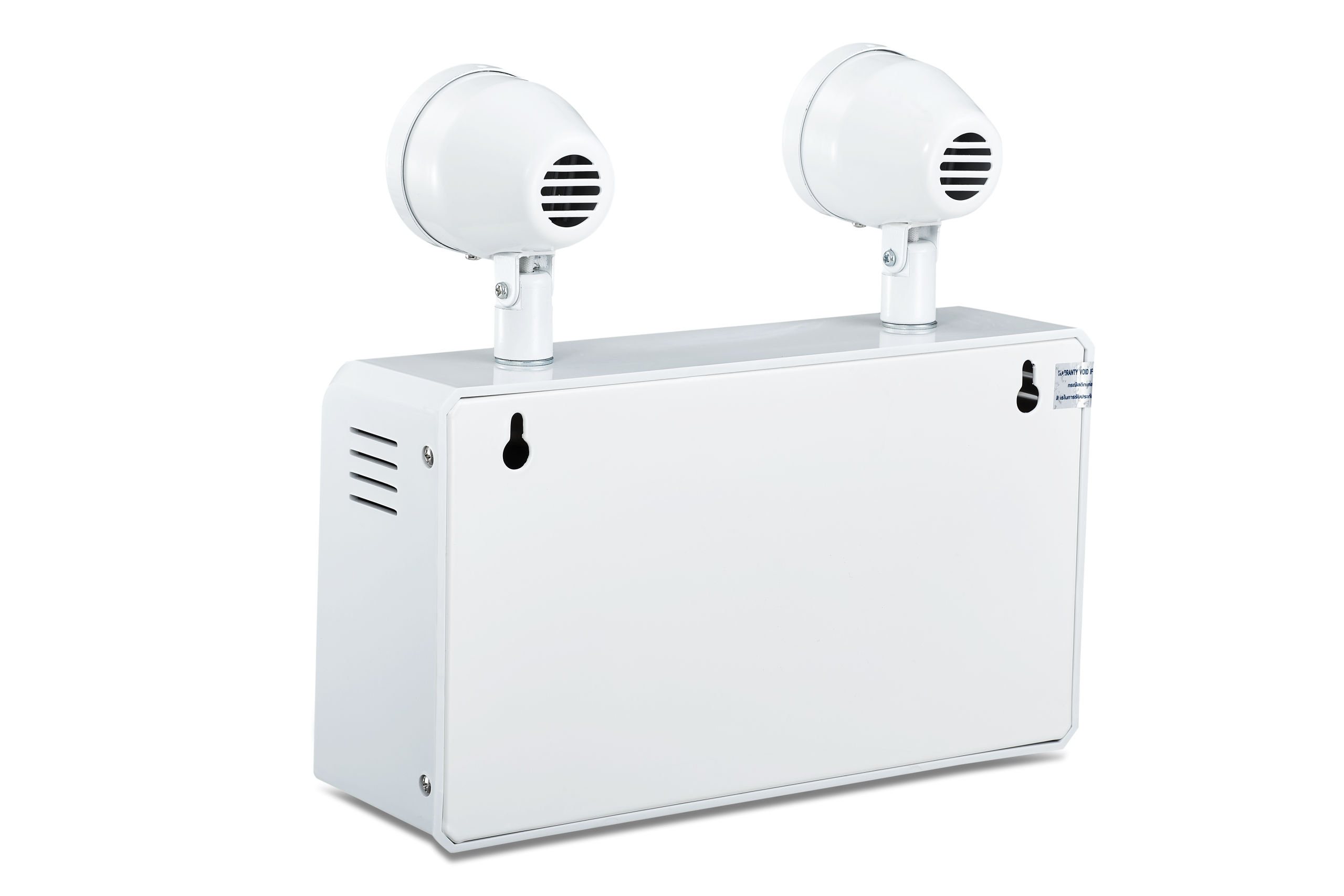
Technical Specifications
Mode of Operation | Non-Maintained |
Operation Temparature
| 10 to 50°C |
Input Voltage | 220-240 VAC / 50Hz |
LED Lamp Power | 9W / 12W Per Bulb (2 options) |
Color Temperature | Warm White (3000K ± 250K) Daylight (6000K ± 250K) |
Luminous Intensity
| 870.8 lm, Warm White (9W) 919.4 lm, Daylight (9W) 957.8 lm, Warm White (12W) 960.1 lm, Daylight (12W) |
Rated Beam Angle | 50 ° |
Battery Type | Lithium Iron Phosphate (LiFePO4) |
Protection Features
| • AC,DC Fuse. • Battery Low Voltage Cut-Off • Surge Protection |
Testing Systems | • Auto Check • Auto Test • Manual Test or Remote Test |
Charging Method
| 3 Steps Charger System
|
Charging Period
| 10-15 Hrs
|
Backup Time | 3.0 / 4.0 / 6.0 Hrs. (3 options)
|
Housing | Plastic ABS Casing and Electro-galvanized steel sheet 1mm. thick |
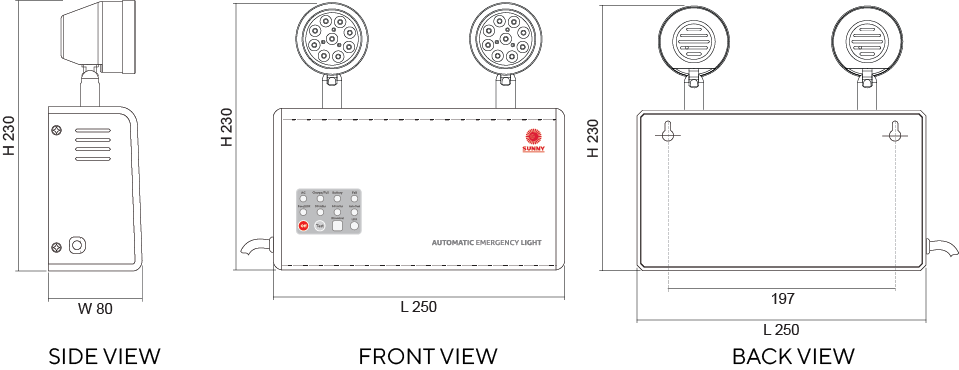
Dimensions (LxWxH) | 250 x 80 x 230 mm |
Weight | 1.86-2.10 Kg |
Degree of Protection
| IP20 |
Mounting
| Wall Surface
|
Accessory
| Infrared Remote Test (RT-S3) |
Standards / Compliance
| • TIS.902 Part2(22)-2560 • TIS.1955-2551 • ISO9001 • CE |
Features
- Bulb
- Highly efficient and super bright LEDs provides maximum brightness while saving on power consumption. It also offers long operational life of more than 50,000 hours
- Battery
- Use Lithium Iron Phosphate (LiFePO4) , It has the advantages of light weight, long service life and high power. It also causes less pollution
- Functions
- Auto Check for key components abnormalities such as the battery, bulbs, fuses, lighting circuits, and battery charging system
- Auto Test schedule: 1 month every 15 minutes, 1 year every 120 minutes (according to standard TIS.021004-22), activate and deactivate functions with a remote control
- The operation can be tested manually (Manual Test)
- A 5-second, 30-minute or 60-minute self-test can be performed on the unit using the remote
- Light Detector (LDR) can be enabled to operate during a power outage when the light level is below 5 Lux
- Circuit Systems
- Controlled by an 8-bit microcontroller circuit
- A Timer Delay circuit to keep the unit operating for a few more seconds once normal power has returned
- Automatic control system activates when the voltage drops (Under Voltage)
- System control via a smartphone application using Bluetooth technology
- Protection Features
- AC and DC fuse to prevent current overload
- Surge Protection
- IP20 dust and water resistant
- Features to Extend Battery Life
- An innovative 3 Steps Charger System
- A Low Voltage Cut-Off to prevent the battery from draining completely
- Continuous monitoring and checking system for the battery charging status
- Battery voltage change rate monitoring system with respect to time (dv/dt)
- Warning Systems
- An LED will blink once every 15 seconds, accompanied by an audible alarm, to indicate that the system is about to stop functioning due to a low battery (Battery Low)
- An LED will blink 3 times every 15 seconds to indicate that the system performs a battery test and detects that the backup lighting emergency duration is less than specified testing time (Battery fail)
- An LED will blink 4 times every 15 seconds to indicate that there is a problem charging the battery (Charging Fail)
- An LED will blink 5 times every 15 seconds to indicate that an abnormality in the lighting system (Lighting Fail)
User Manual & Demonstration VDO
Download the user manual, watch usage tutorial videos, or view battery replacement steps.
Indicators
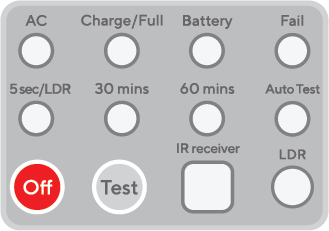
LED AC
| Indicates input status |
LED Charge/Full
| Indicates charging status |
LED Battery | Indicates the system is ready for operation |
LED Fail
| Indicates a system malfunction |
LED 5 sec/LDR
| Indicates the 5-second system test status and the light detection sensor operation |
LED 30 mins
| Indicates that the 30-minute test is enabled |
LED 60 mins
| Indicates that the 60-minute test is enabled |
LED Auto Test
| Indicates the status of the automatic battery test |
Switch Off
| Used to turn off the test and shut down the system |
Switch Test
| Used to test the readiness of the system (while plugged in) |
IR receiver
| Infrared signal receiver |
LDR | Light detector sensor |
Dimensions (mm)
MCU-BT Series | Spec Sheets
Model | Lamp (Bulb) | Lamp (Wattage) | Battery Capacity | Back up (hr.) | Length (mm) | Width (mm) | Height (mm) | Weight (kgs.) |
|---|---|---|---|---|---|---|---|---|
MCU209CD4-BT | 2 | 9 | 12.8V-
4000mAh | 4 | 250 | 80 | 230 | 1.86 |
MCU209CD6-BT | 2 | 9 | 12.8V-
6000mAh | 6 | 250 | 80 | 230 | 2.1 |
MCU212CD3-BT | 2 | 12 | 12.8V-
4000mAh | 3 | 250 | 80 | 230 | 1.86 |
MCU212CD4-BT | 2 | 12 | 12.8V-
6000mAh | 4 | 250 | 80 | 230 | 2.1 |
Frequently Asked Questions about Emergency Lights
What types of buildings are emergency lights suitable for?
Emergency Lights are suitable for all types of buildings — residences, offices, factories, and shopping malls — because the law requires these buildings to install emergency lighting during power outages at key areas such as escape routes, intersections, turns, changes in level, restrooms, or assembly points, to provide sufficient light during fire evacuation or other emergencies.
How many types of emergency lights are there?
Emergency lighting is one of the most important building safety systems. It can be divided into 2 types by battery: the distilled-water refill type, and the dry (maintenance-free) type that requires no distilled water.
When does an emergency light operate?
An Emergency Light operates automatically during a power outage, serving as a backup lighting device inside the building. When normal power returns, the emergency light automatically switches off.
How many hours can an emergency light last?
An emergency light must provide illumination for safe movement along the escape route to a safe point continuously for no less than 120 minutes (per the Emergency Lighting and Exit Sign standard B.E. 2565 / EIT 021004-22).
How often per month should an emergency light be inspected?
Under the EIT standard, inspection is scheduled as follows: inspect upon new installation or after any change in building use; monthly inspection — the function must operate correctly for no less than 30 seconds, and if the battery cannot supply power during the function test, the system must signal a battery failure; and annual inspection — simulating a power-source failure for the full rated duration.
Why does an emergency light blink?
A blinking emergency light indicates its operating status, which may differ by brand and model. For Sunny emergency lights, the blink patterns generally indicate the test/charging status and any battery, charging, or lighting faults (an LED blinking a set number of times every 15 seconds).
At what height should an emergency light be installed?
Emergency lights in escape routes or emergency exits must be installed no less than 2 meters above the floor (measured from the floor to the bottom of the fixture), clearly visible and unobstructed. If installed lower than 2 meters, it must not obstruct the escape route. To extend service life, install indoors away from sunlight and moisture, at a temperature not exceeding 40°C.
Is an emergency light the same as an emergency power backup unit?
No. An Emergency Light operates automatically during a power outage, whereas an emergency power backup unit (UPS) is a backup power source for electrical devices such as computers, protecting them from damage due to power outages or abnormal supply.